AMD has unveiled the Threadripper Halo Station, an extreme-tier AI workstation that pairs a 96-core Threadripper Pro CPU with dual liquid-cooled Instinct MI350P accelerators — a combination the company bills as the most powerful workstation in the world, capable of running trillion-parameter AI models locally. The machine was shown off at IFA, though AMD has yet to announce pricing, a release date, or OEM partners.
The announcement lands as workstation-class AI hardware heats up fast. For more on this story and its rivals' moves, see our ongoing AI hardware news coverage.
The Specs: 96 Zen 5 Cores Plus 288GB of HBM3E
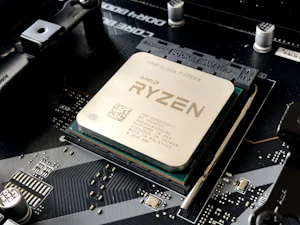
At the heart of the Threadripper Halo Station sits the Threadripper Pro 9995WX, a 96-core, 192-thread Zen 5 chip that boosts up to 5.4 GHz. It ships with 384 MB of L3 cache and a 350W TDP. The chip alone is not a trivial line item: standalone Threadripper Pro 9995WX units have been retailing at roughly $11,000 to $12,000.
The acceleration comes from a pair of AMD Instinct MI350P accelerators, both liquid-cooled. Each card carries 128 CDNA 4 compute units built on TSMC's N3 process and 144GB of HBM3E memory, giving the system 288GB of high-bandwidth memory out of the box. Each accelerator is rated for up to 600W of power draw.
AMD says there is a "path to four" — meaning the platform could eventually support two more accelerators, lifting total GPU memory to 576GB. In the unit demonstrated at IFA, however, there was only physical room for the two liquid-cooled cards alongside the Threadripper host.
System memory tops out at 2TB of DDR5, the maximum supported across the CPU's eight-channel memory controller. That is a staggering figure in its own right: at current market prices, 2TB of DDR5 costs roughly $50,000.
What It Will Cost: Think Six Figures
AMD has not set a price, but the component math tells the story. According to Tom's Hardware, which examined the configuration, taking the core components together — CPU, memory, and dual GPUs — the street price should exceed $100,000 before storage, power, and cooling are factored in. Configured higher, the outlet estimates the workstation "could very easily climb over $150,000."
The machine itself is described as essentially a server tray reconfigured into a tower enclosure. AMD did not share extensive details beyond the specifications, and the company indicated the design is one its OEM partners will ultimately build and ship. No partners have been announced yet, and AMD does not appear to plan on selling the MI350P-based workstation configuration directly itself.
AMD's Claim: Trillion-Parameter Models on a Desk
The headline claim from AMD is that the Threadripper Halo Station can run trillion-parameter models. That is the function of the enormous unified memory story: with 288GB of HBM3E across the two accelerators — and potentially 576GB in a four-GPU configuration — models that would normally demand a data-center server can, in theory, be loaded and run locally.
The claim drew immediate scrutiny from hardware enthusiasts. Large language models with a trillion parameters typically require quantization to fit in available memory, and system RAM at 400–500GB/s of bandwidth is far slower than GPU memory, making PCIe transfer speeds a potential bottleneck for workloads that shuffle data between CPU and accelerators. In practice, models would likely remain resident in GPU memory during inference, with the CPU and its 2TB of DDR5 supporting development tasks around the model.
How It Stacks Up Against Nvidia and Lenovo
The Threadripper Halo Station enters a niche but fast-growing market for desk-side AI supercomputers. Nvidia's GB300-powered DGX Station desktop tower has been listed online at nearly $100,000. At the accessible end, AMD itself recently positioned the $3,999 Ryzen AI Halo as a challenger to Nvidia's DGX Spark — a machine aimed at developers rather than trillion-parameter workloads.
There is precedent for even higher price tags in this class. The Lenovo ThinkStation P8, which uses Threadripper Pro CPUs as a host, currently lists at $334,463 when maxed out with 2TB of DDR5 and dual Blackwell accelerators. Against that backdrop, a six-figure Halo Station would not be an outlier.
Why It Matters
The Halo Station signals AMD's intent to contest every layer of the AI compute stack — from $3,999 desktops to data-center GPUs — rather than ceding the high-end workstation to Nvidia's DGX line. For labs, enterprises with strict data-sovereignty requirements, and researchers who need frontier-scale models behind a firewall, a liquid-cooled, 96-core desk-side system with 288GB of HBM3E could be a compelling alternative to cloud rental.
The open questions are the ones AMD has not answered: final pricing, a release date, and which OEMs will actually build it. Given that the machine debuted at IFA without partners attached, those details are expected to emerge in the coming months. What is already clear is that the boundary between "workstation" and "data center" keeps moving — and AMD intends to push it further.
---
Stay Ahead of AIGet the latest AI news, analysis, and breakthroughs — all in one place.
Read more AI news →