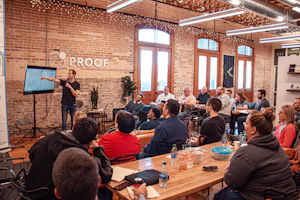
Anthropic co-founder and head of policy Jack Clark brought one of the boldest economic forecasts in the AI debate directly to the world's central bankers and finance ministers: artificial intelligence, he argued, is improving quickly enough to expand the US economy by close to half its current size within four years.
Clark delivered the Per Jacobsson Foundation Lecture at the IMF–World Bank Annual Meetings in Bangkok, according to Reuters, using the podium traditionally reserved for heavyweight economic policy addresses to argue that governments need to start planning for AI-driven growth now — not after it arrives.
For ongoing coverage of AI's economic and policy impact, follow the latest AI news on AI Buzz Wire.
Three Scenarios for 2030
The numbers behind the speech come from Anthropic's own Economic Scenario Explorer, an internal modeling tool the company published in September. It lays out three paths for the US economy through the end of the decade, and the spread between them is enormous.
In the modest scenario, AI diffuses through the economy at roughly the pace the internet did. US gross domestic product reaches $34.1 trillion by 2030 — barely 1.6 percent above where the economy would land without transformative AI.
In the substantial scenario, AI systems autonomously handle about half of knowledge work. GDP climbs to $36.3 trillion, an 8.3 percent lift over the no-AI baseline.
The extreme scenario is the one Clark put front and center: AI outperforms humans on nearly every knowledge-work task, leaving little comparable work for people to move into. GDP reaches $44.4 trillion — more than 30 percent above the baseline, and roughly $10 trillion in added output compared with the path where AI changes little.
To put that in perspective, the gap between the modest and extreme scenarios is larger than the entire annual GDP of every country on Earth except the United States and China.
'Moves Unimaginable Today'
Clark's message to the room was that even the lower scenarios demand preparation. "If you end up with this level of GDP growth, you have moves available to you as a policymaker that are unimaginable today," he told the audience, according to Reuters.
The implication cuts both ways. A $44 trillion economy could fund social programs, scientific research, and debt reduction at scales currently impossible. But a transition that fast would also strain labor markets, tax systems, and social contracts designed for a world where human labor is the primary source of both income and government revenue.
The speech continues a pattern for Clark, who has emerged as one of the most active policy voices among AI lab executives. In September, he told the BBC that governments may need to require AI companies to install verifiable "kill switches" — mechanisms for shutting down dangerous systems, checked by outside inspectors — signaling that Anthropic's policy agenda pairs aggressive growth forecasts with aggressive safety proposals.
A Lab Selling the Upside It Fears
The forecast deserves scrutiny on one point: it comes from the economic model of a company whose valuation and revenue depend on AI adoption accelerating. Anthropic, which is preparing for a public listing after filings projected revenue approaching $200 billion by 2028, benefits directly from policymakers and investors internalizing optimistic scenarios.
External economists have repeatedly urged caution about lab-generated economic projections, noting that productivity gains from previous general-purpose technologies took decades to appear in official statistics, and that early AI measurement studies show modest effects so far. The Economic Scenario Explorer's scenarios are explicitly conditional — none of them is a prediction — but the extreme case is the number that travels.
Wall Street Is Nervous Anyway
Clark's optimism lands amid a rough stretch for the AI trade. Reuters reported this week that a market selloff and rising interest rates are testing the massive data-center financing boom underwriting the AI buildout, with investors questioning circular supplier arrangements and the speed at which compute commitments can generate returns.
Anthropic itself has been one of the biggest beneficiaries of that financing wave, locking in tens of billions of dollars in compute arrangements — including a multibillion-dollar cloud deal with Nscale for a West Virginia campus and a chip-leasing arrangement with Broadcom — as it races to secure capacity for frontier training runs.
That tension — between economic forecasts measured in tens of trillions and financing markets that wobble at the first rate scare — framed Clark's core argument: the uncertainty runs in both directions, and the cost of planning for growth that arrives is smaller than the cost of being surprised by it.
Whether central bankers in Bangkok buy the $44 trillion scenario or not, the lecture marks a shift in the AI policy debate: the question is no longer only how to manage AI's risks, but how to manage an economy that Anthropic's models suggest could look radically different four years from now.
---
Stay Ahead of AIGet the latest AI news, analysis, and breakthroughs — all in one place.
Read more AI news →