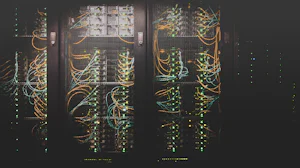
Lumilens, a startup building optical connectivity systems for large-scale AI data centers, emerged from stealth on August 6, 2026 with more than $900 million in total funding and a $5.51 billion valuation. The Wall Street Journal first reported the raise, with the company confirming that its latest financing round exceeded $700 million and was co-led by Atreides Management, Bain Capital Ventures, Meritech, Seligman Ventures, and Spark Capital.
The launch arrives at a moment when the bottleneck constraining AI has shifted. "The constraint on AI has shifted from how many GPUs you can buy to how many you can connect," the company said in announcing the round. For the deeper picture on the hardware powering this buildout, follow our AI industry coverage at aibuzzwire.news.
Connecting GPUs With Light
Founded two years ago, Lumilens is already shipping its first product into production AI data centers through what it described as a multibillion-dollar customer agreement with a major hyperscaler. The company designs optical interconnects for both scale-up networks, which connect GPUs inside tightly coupled computing systems, and scale-out networks linking racks and clusters throughout data centers.
The technology aims to replace the copper wiring and conventional transceivers that currently move data between processors with light-based connections that can carry far more information over distance with less power. Lumilens frames the problem in stark terms: a 400,000-GPU data center can require more than 2.4 million optical transceivers and over five million fiber strands, and industry projections indicate significant shortages of both 800-gigabit and 1.6-terabit transceivers.
The LumiCore Platform
Lumilens's portfolio is built on LumiCore, an internally developed technology platform spanning silicon photonics, mixed-signal integrated circuits, electrical-optical interposers, and optical systems. Its shipping and in-development products include near-package optics, co-packaged optics, and pluggable 800G and 1.6T transceivers.
The combination is designed to cover the full stack of connectivity a modern AI factory demands — from the short, dense links binding GPUs together inside a system to the high-bandwidth pipes shuttling data between racks. By owning the underlying silicon and systems, Lumilens is betting it can manufacture at the volume and pace the AI buildout requires rather than relying on a fragmented supplier base.
A Crowded and Critical Market
The round underscores how investor capital is flowing toward the plumbing of AI rather than just the models. Optical interconnects have become one of the most hotly contested corners of AI hardware, as hyperscalers race to connect ever-larger clusters of GPUs. The shortage of high-speed transceivers has become a recurring theme in earnings calls across the industry, with Nvidia, AMD, and the major cloud providers all citing connectivity as a limiting factor on how fast they can expand compute capacity.
Lumilens enters a field that already includes specialists like Eliyan and Astera Labs alongside the optical units of the incumbents. Its differentiation rests on delivering a vertically integrated product line — silicon, packaging, and pluggables — rather than competing on a single component. That vertical breadth is also its principal execution risk: building custom silicon photonics, mixed-signal chips, and high-volume optical assembly simultaneously is a capital-intensive undertaking that few startups have managed at scale.
The technical challenge is compounded by physics. As data rates climb toward 1.6 terabits per second, the tolerances on optical alignment, thermal management, and signal integrity tighten dramatically. Components that work in a lab demo often falter when they must be manufactured in the millions and survive the vibration and heat of a packed data center floor. Lumilens's claim that it is already shipping into production environments suggests it has crossed at least the initial manufacturing hurdle — but scaling from early shipments to the volumes a hyperscaler demands is where optical startups have historically stumbled.
The Investor Lineup
The breadth of the syndicate signals the scale of conviction behind the thesis. Beyond the co-leads, the round included Addition, Alkeon, HarbourVest, J.P. Morgan Private Capital, Mayfield, MVP Ventures, Qualcomm Ventures, Peak XV, Redpoint Ventures, and Seifdune. The presence of Qualcomm Ventures is particularly notable, tying Lumilens to one of the largest silicon and connectivity players in the industry.
Lumilens said the new funding will expand its silicon, systems, software, process engineering, and high-volume manufacturing operations. "We built Lumilens to deliver both, and to manufacture at the volume, quality and pace this buildout demands," the company said — a direct reference to its bet that the winners in optical interconnects will be those who can ship, not just design.
What Comes Next
For an industry that has spent the last two years obsessing over GPU supply, Lumilens's emergence is a reminder that the next constraint is the network connecting those chips together. As clusters grow toward the million-GPU mark, the copper and transceivers linking them become the limiting factor on how much of that compute can actually be used at once.
Whether Lumilens can deliver at hyperscale — and whether its multibillion-dollar hyperscaler agreement translates into volume shipments — will determine whether a $5.5 billion valuation looks conservative or aspirational. Either way, the message from investors is clear: in the AI hardware stack, the connection is now as valuable as the chip.
---
Stay Ahead of AIGet the latest AI news, analysis, and breakthroughs — all in one place.
Read more AI news →