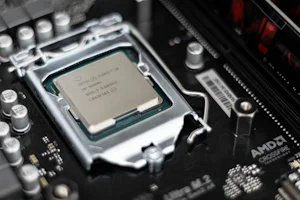
Xiaomi has unveiled three new self-developed processors — the Xring O3, O100, and D100 — alongside a striking AI Cube mini PC prototype that pairs all three chips to run a 120-billion-parameter model entirely on-device. The announcements, made at the company's launch event on August 24, 2026, represent the Chinese electronics giant's most aggressive push yet into custom silicon, with Bloomberg reporting the move directly challenges Qualcomm and MediaTek's dominance in mobile processors.
The chip rollout spans three distinct markets: smartphones, on-device AI inference, and automotive systems. Reuters reported that Xiaomi has partnered with TSMC for production, according to sources familiar with the matter. For more context on this story, see our ongoing AI industry coverage.
Xring O3: A Flagship Phone Chip With LPDDR6
The Xring O3 is Xiaomi's new flagship smartphone processor, built on TSMC's 3-nanometer process. According to technical blog AiCybr, the chip pairs a 10-core CPU with a 16-core G2-Ultra NX GPU and a neural processing unit rated at 200 TOPS.
Tech Times and tbreak report that the O3 is the first mobile chip to ship with LPDDR6 memory and the first phone processor to top 5 million points on the AnTuTu benchmark. The chip will debut commercially in Xiaomi's 18 Fold foldable flagship in September, which is already up for preorder.
The launch positions Xiaomi alongside Apple, Google, and Samsung as one of the few phone makers designing its own high-end silicon — a strategy aimed at reducing reliance on Qualcomm's Snapdragon lineup, which still powers much of Xiaomi's current portfolio.
Xring O100: 3D-Stacked Memory for On-Device AI
The most technically ambitious of the three is the Xring O100, a dedicated high-bandwidth AI accelerator built for running large models locally. The 6-nanometer chip uses 3D wafer-level packaging to stack two DRAM dies directly on top of the logic die using hybrid bonding with face-to-face metal-layer connections.
The approach yields 28,672 effective data lines between memory and compute — a dramatic increase over the 96 lines in a conventional package-on-package design — and delivers 1.22 TB/s of near-memory bandwidth. Xiaomi says that is 16 times the memory bandwidth of its flagship phone reference platform.
In a demonstration, the O100 ran Xiaomi's MiMo 3B model at up to 330 tokens per second using roughly 10 watts of active air cooling. The company plans commercial rollout of the O100 in 2027.
Xring D100: Smart Driving With 160GB of Unified Memory
The third chip, the Xring D100, targets autonomous driving. Built on a 3-nanometer process, it combines a 20-core CPU with a 16-core NPU and supports up to 160GB of unified memory, according to CnEVPost. Xiaomi plans commercial deployment in its vehicles starting in 2027.
The large unified memory pool is designed to keep large driving models resident on-chip, a growing requirement as automakers move from small perception networks to vision-language-action models that reason about the road.
What the O100 Changes for Local AI
The O100's design philosophy mirrors a broader industry shift. As large language models have grown, the bottleneck for local inference has moved from raw compute to memory bandwidth — every generated token requires re-reading model weights from memory. By stacking DRAM directly above the NPU using hybrid bonding, Xiaomi shortened and widened that path dramatically, achieving bandwidth levels approaching discrete graphics cards while remaining within a power envelope suitable for compact devices.
For context, AiCybr's analysis notes that an Nvidia RTX 5090 provides 1.792 TB/s of GDDR7 memory bandwidth — meaning the O100's 1.22 TB/s brings desktop-class data throughput to a chip sipping a fraction of the power. That is what makes the 120B-parameter claim for the AI Cube plausible: with enough bandwidth and a fast/slow dual-model architecture routing most tokens through the smaller 3B model, the system can keep latency low while reserving the heavyweight model for difficult reasoning steps.
The AI Cube: A Desktop AI Supercomputer
To showcase the three chips working together, Xiaomi demonstrated the AI Cube, a compact aluminum mini PC that combines the O3, O100, and D100 in a single 150-watt system. The prototype runs a dual-model configuration — a 120-billion-parameter model paired with a nimble 3-billion-parameter model — switching between fast and slow reasoning modes locally, with no cloud connection required.
The chassis is machined from aerospace-grade aluminum with 33,874 CNC-machined ventilation perforations. Xiaomi has not announced pricing or a release date, positioning the Cube as a technology demonstration for now.
China's Silicon Self-Sufficiency Drive
The Xring family lands amid intensifying US-China technology tensions. Washington has moved in recent months to restrict Chinese access to advanced AI chips, while Beijing has poured state support into domestic semiconductor development. Xiaomi's ability to design 3nm-class chips and manufacture them at TSMC — at least for now — illustrates how Chinese consumer giants are hedging against supply disruptions.
For Qualcomm and MediaTek, the message is unmistakable: their largest customers are increasingly becoming competitors. Qualcomm is preparing 2nm silicon as the next battleground, Android Headlines noted, but Xiaomi's vertical integration gives it control over the AI pipeline from chip to model to device — the same playbook Apple has refined over a decade.
Whether Xiaomi can match the modem and software maturity of the incumbents remains an open question. But with three custom chips, a local AI runtime, and a 2027 commercialization roadmap, the company has signaled that the era of Chinese OEMs as passive chip buyers is drawing to a close.
---
Stay Ahead of AIGet the latest AI news, analysis, and breakthroughs — all in one place.
Read more AI news →